?

?

Friday, 19 August 2016

Willington Cooling Towers

This site had been on my Urbex "to-do list" for quite some time. On a sunny August day, after a failed attempt to access a mill in Derbyshire with Judderman, the chance presented itself to me to get it ticked off the list.


A little history, courtesy of Wikipedia:
In the 1950s, two coal-fired power stations were built on a site off Twyford Road, between Willington and Findern. The stations were privatised and sold to National Power in the early 1990s and eventually closed in the mid-1990s. Although most of the stations were demolished at the turn of the millennium, the five cooling towers continue to dominate the skyline of the local area. The site is earmarked for a large residential development, pending the results of a public inquiry. The construction plans have been met with local opposition, perhaps due to the site's proximity to the River Trent's flood plain. In the mid-1990s a pair of peregrine falcons nested in one of the site's huge cooling towers. Unlike many bird of prey breeding sites, this was widely publicised because of its impregnable location.
The power station was also the subject of a short documentary by Channel 4 titled "Drones in Forbidden Zones".

It seemed that many other explorers had trodden the well-established path through the long grass towards the five cooling towers.

 
The first tower was clear inside, save for a box of spent fireworks in a box labelled "Power Station Firework Party". That must have been some party - the acoustics in there were amazing - just throwing an average sized stone on the ground resulted in an impressive gun-shot sound!


Standing in the centre of the cooling tower, looking up at the opening was awesome!


Onto the third cooling tower. The third, fourth and fifth towers were of a different design internally.
 
 
The sheer size of the towers is astonishing.
 
 
This concrete beam was just asking to be walked on!


The view, looking up from the centre of the tower (at the end of the beam)


And that was that - what a shame that these fabulous structures will soon be demolished!


Monday, 20 June 2016

The Pink Widow's Cottage

Somewhere in deepest darkest Lancashire stands a cottage in a garden that has been overtaken by weeds, nettles and thistles! I am calling it "The Pink Widow's Cottage" as that is what the urbex couple who told me about it called it. It was a stroke of luck that I bumped into them on a previous urbex trip or I'd never have known about this place. I haven't seen it on any of the urbex sites.
After struggling through the jungle of a "garden" and getting attacked by the thorny plants, a few good shoves and I was in through the front door. This was a rare solo visit for me, it being a school day and all . . .


I have no idea of the history of the place but it seems to have been abandoned for some time, judging by the décor and the amount of cobwebs around the place. Trying to guess what the person who lived here was like is a good game to play as you wander around. I shall go with the "widow" theme and say that she was an animal lover as there were large posters of a rabbit and a robin above the fireplace.


Into the front parlour, where there are several different layers of wallpaper peeling off the damp walls.

 There are two armchairs which have definitely seen better days!


 This fireplace reminded me of the one that my grandparents had when they lived in an old cottage. I remember them cleaning it out at night and getting it lit with newspaper on cold winter mornings.


 Some distinctly 1970s wallpaper covering the chintzy pink rose wallpaper underneath.


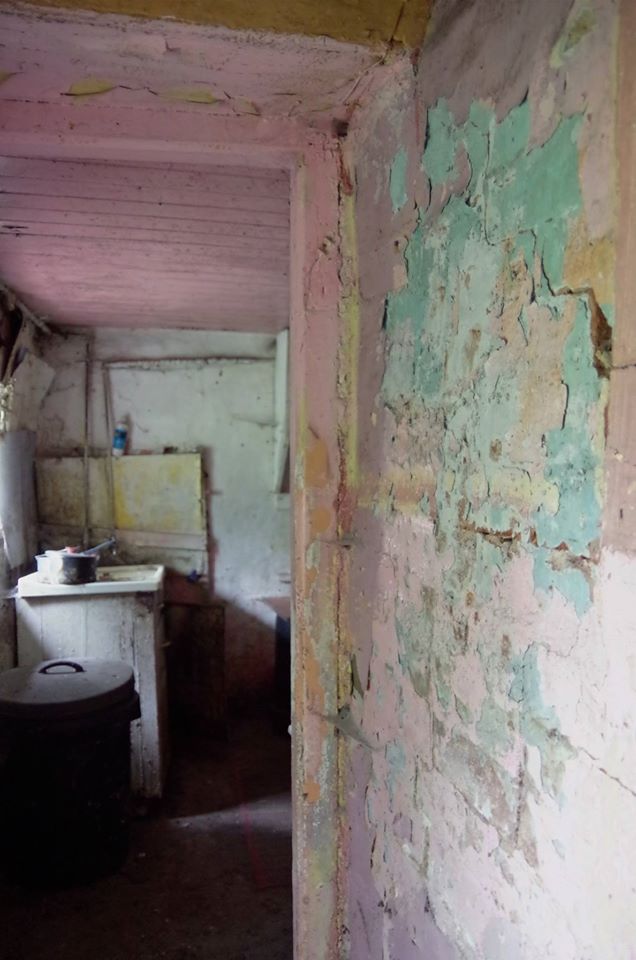
 The kitchen made my student house kitchen look positively palatial! The units were wonky, filthy and the windowsill was covered in cobwebs. There were pans left on the draining board as if the widow had just popped out to the shops.


Through the kitchen was another small room which contained a washday mangle used wring out wet clothes from the washtub. Again, this reminded me of my grandma as she used to tell me how she helped her mother out on wash days by putting shirts through the mangle in the 1920s and 30s.


There was a very dark and dingy downstairs toilet with this tiny window with a tiled surround. I didn't venture upstairs on this visit as I was alone and the first few steps seemed very fragile - I didn't want the stairs to collapse as I was halfway up with no phone signal! Maybe next time? It is definitely worth a second visit, as although it is tiny, there is plenty of interest to photograph. It was quite a sad explore, thinking of the widow who probably lived here alone and wondering what happened to her - did she die here or end up in a nursing home or hospital?